Rescuing an AI Product Roadmap Through Rapid Talent Deployment
Vishwanadh Raju
07 Feb 2026
•
3 min read
Solving a Critical Talent Bottleneck for a High-Growth AI Technology Company Through Rapid, Precision Hiring
Executive Summary
A rapidly scaling AI technology company was preparing for a milestone product release that relied on real-time inference, improved model accuracy, and a re-engineered ML deployment pipeline. But the company faced a major roadblock: they lacked the senior-level deep-tech talent required to execute the final stage of their roadmap.
Their hiring cycle had stalled for months despite aggressive outreach. Senior AI engineers declined interviews, shortlists were thin, and market competition was unforgiving. With only weeks left before internal deadlines, leadership engaged Plugscale to solve a problem that felt impossible: close multiple super-niche AI roles in just two weeks.
Plugscale built a rapid talent intelligence–driven hiring sprint that delivered what the client had struggled with for months: credible candidates, fast interviews, and decisive closures. The result was a fully staffed AI engineering pod, product continuity, and a replicable model for future deep-tech hiring.
AI Hiring Sprint Impact
Time to Close
14 Days
Previous Cycle
~12 Weeks
Interview Ratio
1:3
Offer Declines
0
First Shortlist
36 Hours
Hiring Cost Reduction
~40%
Industry Background
AI companies today operate on aggressive product cycles. Success often hinges on the availability of talent capable of working across:
Deep learning model design
NLP systems and LLM optimization
Computer vision engineering
ML Ops and scalable deployment frameworks
Applied data science
These roles require rare cross-functional expertise and the global market for such talent is extremely tight. Engineers with this background are few, heavily competed for, and often absorbed by major AI labs, FAANG companies, or unicorn startups.
Speed is everything. When AI roles stay unfilled, product roadmaps collapse, compute costs rise, deployment pipelines stall, and business opportunities slip away. This was the exact situation Plugscale stepped into.
Global Scarcity of Applied AI Engineers
Research AI Talent Pool
Applied Production AI Engineers
ML Ops Specialists
LLM Optimization Engineers
Client Situation
The client had raised fresh funding and was under pressure to ship major product upgrades across NLP, Vision AI, and ML Ops. Their core team was strong, but overstretched they needed specific expertise immediately:
NLP Engineer for model optimization
Computer Vision Lead for inference pipelines
ML Ops Engineer to redesign deployment workflows
Applied AI Scientist for dataset tuning and experimentation
After 10–12 weeks of internal effort, they had:
<5% relevant profile match rate
Poor interview-to-offer conversion
Repeated drop-offs due to slow process
Unrealistic compensation benchmarking
A hiring funnel that simply wasn’t working
The CEO and CTO agreed: “This product release will slip if we don’t fix talent before it becomes a roadmap risk.
Hiring Funnel – Before Plugscale
Stage
Status
Relevant Profile Match
< 5%
Interview Conversion
Low
Time to Fill
10–12 Weeks
Offer Declines
Frequent
Process Clarity
Inconsistent
Strategic Pain Points
The talent pool for senior AI engineers was extremely thin, especially with experience in end-to-end product pipelines (not just research).
Job descriptions were too academic, scaring away industry practitioners who excel in applied, production-grade AI.
Competitors were aggressively hiring, inflating salary expectations and pulling talent away.
Leadership had no real-time visibility into AI talent supply, making hiring decisions feel like guesswork.
Plugscale needed to solve all five pain points — immediately.
Plugscale Intervention
Rather than “recruiting,” Plugscale treated this as a mission-critical deep-tech talent operation. We built a 48-hour rapid response framework, combining talent intelligence, role recalibration, and targeted sourcing to eliminate inefficiencies and move straight to qualified, available candidates.
What We Did
1. Reframed the Roles With Precision
The first breakthrough came from rewriting the role definitions to reflect real production needs rather than theoretical research expectations. We:
All critical roles closed in 14 days (previous cycle was ~12 weeks).
Delivered the first shortlist within 36 hours.
Achieved 1:3 interview-to-offer ratio, far above industry averages.
0 offer declines — every accepted candidate joined on schedule.
Built a plug-and-play AI hiring framework for all future expansions.
Impact & ROI
1. Product Release Stayed on Track: Without these hires, the release would have slipped by 6–8 weeks.
2. Engineering Velocity Improved: The new ML Ops and CV engineers accelerated model deployment and reduced inference latency by redesigning pipelines earlier in the cycle.
3. Hiring Cost Reduced by ~40%: Rapid closures eliminated prolonged sourcing cycles and agency dependencies.
4. Stronger Employer Brand Among Deep-Tech Talent: A structured, respectful, fast hiring process positioned the client as a credible AI employer.
5. A Repeatable AI Hiring Engine: Leadership no longer feared scaling — they had a proven model.
Business Impact Snapshot
Area
Before
After
Hiring Cycle
12 Weeks
14 Days
Product Delay Risk
6–8 Weeks
Eliminated
Cost Leakage
High
Reduced 40%
Delivery Confidence
Low
High
Strategic Advantage for the Client
Ability to compete with larger AI labs for niche talent.
Greater agility in responding to product opportunities.
Stronger execution capability across NLP, CV, and ML Ops.
Reduced dependency on contractors or agency-driven hiring.
Confidence to plan future releases based on predictable hiring velocity.
Implementation Snapshot
Day 0–1: Alignment + role clarity Day 1–4: Talent intelligence + sourcing sprint Day 4–10: Technical rounds + decision loops Day 10–14: Offers → onboarding → risk management
A complete transformation in two weeks.
AI Hiring Market Reality
ML Ops and inference optimization roles rank among the hardest AI roles globally.
Senior applied AI engineers represent less than 15% of the total AI workforce.
Top-tier AI candidates often close offers within 3–5 days.
Competition driven by funded AI startups and Big Tech labs.
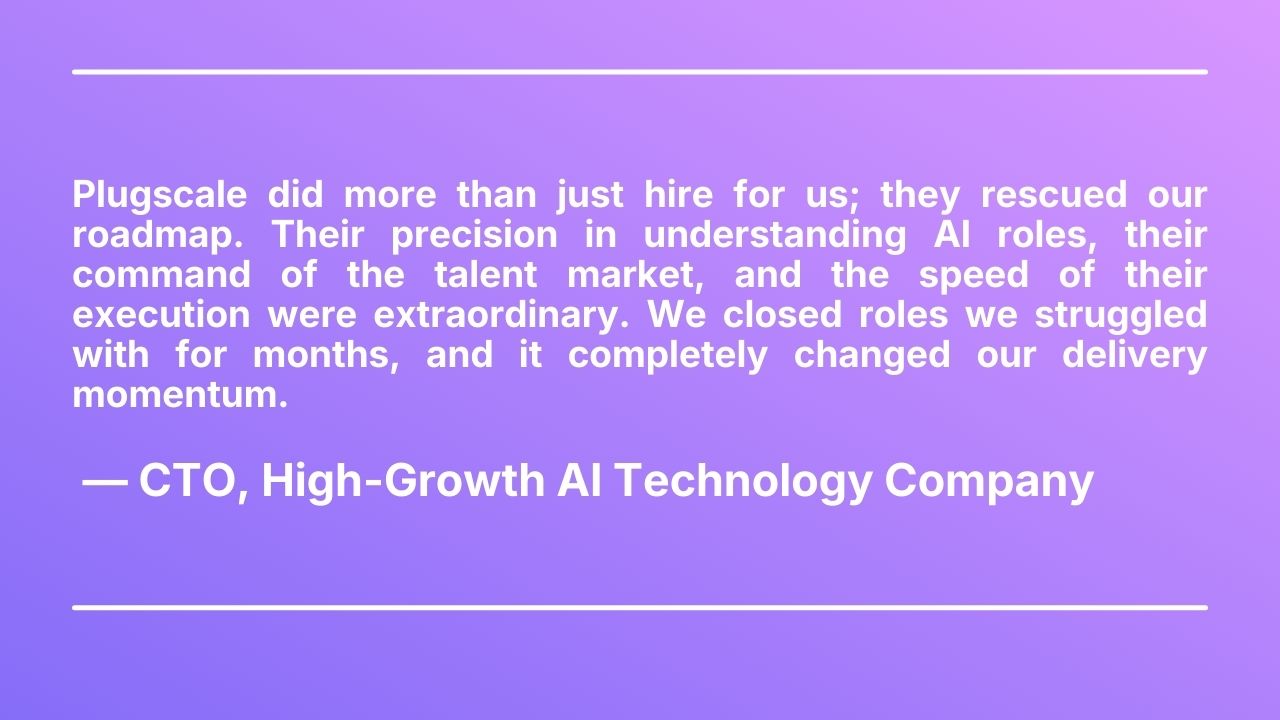
Testimonial
FAQs
Why is hiring senior AI talent so difficult globally?
Senior applied AI engineers are rare because most professionals specialize either in research or implementation — not full product pipelines. Companies need engineers who can design, deploy, optimize, and scale AI systems in production environments, and that combination is scarce and heavily competed for by Big Tech and funded AI startups.
What made Plugscale close these AI roles in just 14 days?
We eliminated inefficiencies. By redefining roles around production needs, mapping micro talent clusters, targeting active and passive AI engineers precisely, and compressing interview cycles into structured sprints, we turned an unpredictable hiring process into a controlled execution model.
Which AI skills are currently the hardest to hire?
ML Ops architecture, inference optimization, deep learning engineering, advanced NLP/LLM optimization, and engineers who can manage end-to-end deployment pipelines are among the most competitive and supply-constrained roles globally.
Where does top-tier applied AI talent exist in India?
Strong AI ecosystems exist in Bengaluru (CV & ML Ops), Hyderabad (NLP & LLM), Pune (Applied AI product engineering), and select deep-tech clusters in Chennai. However, targeting requires role-specific intelligence — not generic sourcing.
Can this rapid AI hiring model scale for long-term team expansion?
Yes. The sprint framework is repeatable. Once role clarity, evaluation design, and talent intelligence layers are built, companies can scale AI pods predictably without restarting the hiring learning curve each time.
Building in India? Start with PlugScale.
Launch your GCC with the right talent, setup, and systems – without the mess.